 IFTTT Autopost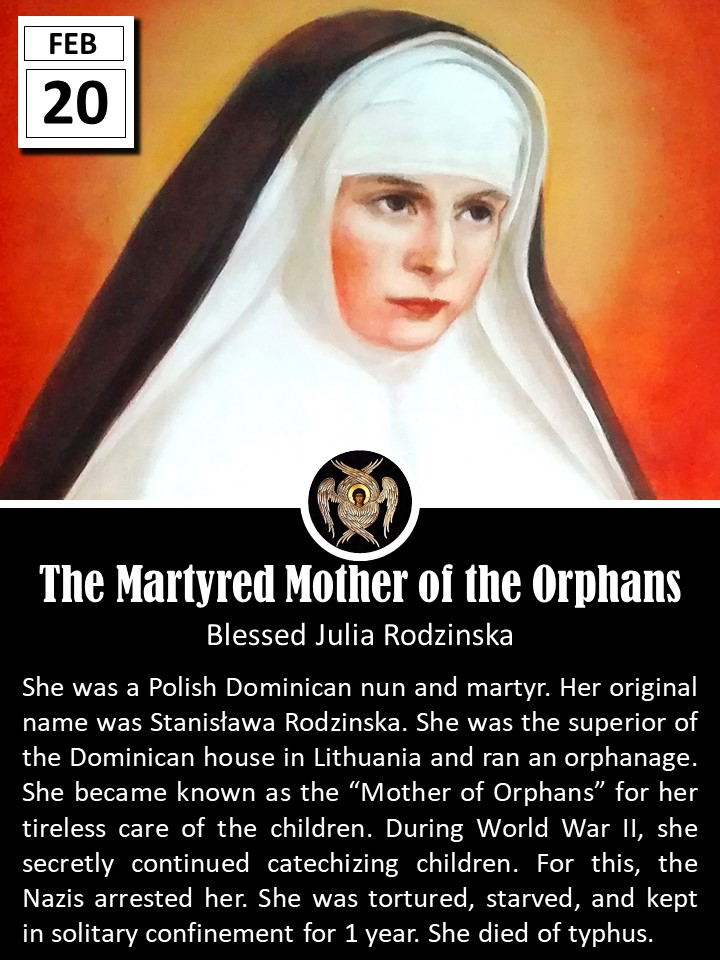
Stanislawa Maria Jószefa Rodzińska was born on March16, 1899 in Nawojowa in southern Poland. Stanislawa was one of five children of Michal, an organist, and his wife Marianna (nee Sekula).
When Stanislawa was ten, she was orphaned and sent to the Dominican Sisters’ convent in the town where she finished her basic schooling. After graduation, Stanislawa began studying to become a teacher in Nowy Saqz, but she didn’t complete her studies because, when she was 17, she entered the Dominican convent in Tarnobrzeg-Wielowieś. There, Stanislawa made her religious vows, received the name “Maria Julia” in religious life, and finished her teacher’s education.
Sister Julia began her teaching career in Mielżyn, Rawa Ruska, and Vilnius, three places that today are in three nations: Poland, Ukraine, and Lithuania respectively. In Vilnius, today the capital of Lithuania, Sister Julia headed the Dominican house and ran an orphanage. Her dedication to the care of orphans was so great, that she became known as the “Mother of Orphans.”
When World War II, Sister Julia became part of the ant-Nazi underground, doing what she could to serve those in need. She not only taught the Catholic faith, but she also taught subjects such as history and Polish.
On July 12, 1943, the Nazi Gestapo and imprisoned in Lukiškės Prison in Vilnius. The prison, formerly a Catholic monastery, was used during World War II not only for Jewish prisoners, but also for Polish Resistance members like Sister Julia.
On December 13, 1943, Sister Julia was transferred to a Stuttof Concentration Camp in what today is the northern part of Poland. Stutthof should not be confused with Struthof. In the camp, Sister Julia became prisoner # 40992, and there, she suffered from torture, humiliation, and isolation.
Sister Julia died of exhaustion and disease on February 20, 1945. Two months later, the Red Army liberated that camp. Sister Julia was declared “Blessed” in 1999, along with 107 other Polish martyrs. Blessed Maria Julia Rodzinska’s feast day is February 20.