 IFTTT Autopost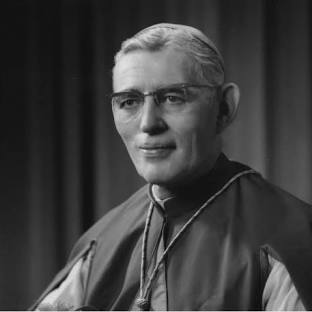
Vincent Joseph McCauley was born on March 8, 1906, in Council Bluffs, Iowa, United States, eldest of six children. His father, Charles, was a wire chief for American Telephone & Telegraph (AT&T) in Omaha, Nebraska, and his mother, Mary Wickman, was a homemaker.
Vincent’s family was a devout Catholic one, active in their parish, St. Francis Xavier in Council Bluffs. In addition to praying a daily rosary, both parents were active members of various groups such as prayer circles, altar guilds, and the Knights of Columbus.
After graduating from Creighton Preparatory School in 1924, Vincent entered Creighton University but left in 1924 to enter the Congregation of the Holy Cross. After his novitiate year, Vincent took his first vows on July 2, 1926, and perpetual vows on July 2, 1929. He graduated from the University of Notre Dame in South Bend, Indiana in June of 1930 and went to the Foreign Mission Seminary in Washington, D.C. He was ordained a Holy Cross priest on June 24, 1934.
Because of the Great Depression that hit the United States, there were not enough funds to send Father Vincent overseas. So, he taught at the Holy Cross’s seminary in North Dartmouth, Massachusetts and was responsible for overseeing its relocation to Easton, MA in 1935.
Finally, in 1936, Fr. McCauley’s dream of becoming a foreign missionary came true when he was assigned to East Bengal, an area that for the most part today is Bangladesh. Until 1944, he served in various roles such as teacher and seminary administrator. Unfortunately, his health remained fragile due to relapses of malaria and other tropical diseases. Therefore, he was sent back to the United States to recover.
During his time in the Untied States, Fr. Vincent spent six years serving in the Foreign Mission Seminary in Washington, and in 1952 he became procurator for his order’s missions. During this period, Fr. Vincent had his first treatment at the Mayo Clinic for skin cancer. By the time he died, he had had over 50 surgeries for skin cancers.
From 1958 to 1961, Fr. Vincent served in the East African nation of Uganda. First, he and other missionaries set up various churches and other institutions. Then, in 1961, he was named by the Vatican to be the founding bishop of a new diocese, the Diocese of Fort Portal. There, he served from 1961-1972.
Fr. McCauley had the honor of being part of all four sessions of the Second Vatican Council. Inspired by the fresh ideas of the Council, he set out to encourage a native clergy, and he fought for the refugees who were arriving from war-torn nations of Rwanda, Democratic Republic of Congo, and Sudan. He invited missionaries from various religious communities to join the new diocesan efforts, and he encouraged women religious to enter new ministries. Also, the new bishop was a big promoter of lay ministry that stemmed from a person’s baptism, and he fostered ecumenical relationships with other Christian people. He did all his work despite suffering at times from malaria, chronic varicose veins, and phlebitis.
On a regional level, Bishop McCauley helped establish the Association of Member Episcopal Conferences in Eastern Africa (AMECEA), and he became its first president. In time, he also established the Gaba Pastoral Institute for the formation of catechists.
Bishop McCauley died on All Saints’ Day, November 1, 1982, and was buried in the Holy Cross Cemetery in Notre Dame, Indiana. He was proclaimed a “Servant of God” in August 2006 when his cause for canonization was introduced. Today, the Diocese of Fort Portal continues exploring his life for the next step in the canonization journey.