 IFTTT Autopost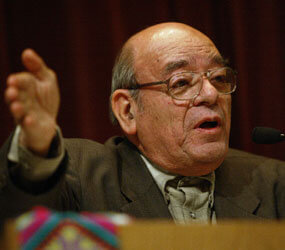
Samuel Ruiz García was born on November 3, 1924, in Guanajuato, Mexico, eldest of five children. His father, Maclovio Ruiz Mejía, worked in agriculture, and his mother, Guadalupe García, was a maid for upper-class families. During his childhood, Catholic Mexicans lived through the Cristero War (1926-1929), when Catholics fought against the ant-Catholic laws of the Mexican government.
Samuel studied in high school and seminary in León, Guanajuato. He was ordained a priest in 1949 and earned a Ph.D. in Sacred Scripture from the Gregorian University in Rome in 1952. As a new priest, Father Samual taught philosophy and theology in the León seminary.
In 1960, Father Samuel was consecrated a bishop and made ordinary of the Diocese of San Cristóbal de las Casas of Chiapas, Mexico. He held this position until he retired in 2000.
The 1960’s were an incredibly exciting and revolutionary time in the Catholic Church, and Samuel was greatly touched by three things which would shape the rest of his life as a shepherd.
First, he visited every part of his diocese, and he was profoundly affected by the grinding poverty and marginalization of the people, especially the indigenous Mayan peoples. He determined to do all he could for the people he served.
Second, Bishop Samuel was affected by the Second Vatican Council (1962-1965). The Council, called by Pope Saint John XXIII, asked Catholic Christians to go back to their roots. Masses were once again celebrated in the language of the people as they were in the ancient Church. The people were encouraged to get to know the Bible better. Lay persons were reminded that they, too, were called to be ministers as a result of their Baptisms, and they, too, shared in the “priesthood of all believers.”
And third, Bishop Samuel was affected by Liberation Theology that swept through Latin American countries. Such a theory rejected the idea that oppression was “God’s will” for the poor and disenfranchised. Liberation Theology held that Christians are called to try to build the Kingdom of God in this life, a kingdom built on love and respect and justice for all people, for all people are children of God.
In 1968, many of the ideas Bishop Samuel had formulated were solidified in what became known as the “Medellín Conference” of 1968. The conference affirmed his idea that the root of poverty and oppression in Latin America was a systemic problem that grew out of expansionism and development of United States imperialism.
Liberation Theory, combined with the renewed focus on the rights and responsibilities of Catholic lay persons to build a better world, led to a host of new and exciting innovations in Latin American churches. And Bishop Samuel, as president of the Department of Missions of The Conference of Latin American Bishops (CELAM), was at the forefront of change. Soon, Catholic priests found themselves encouraging small base communities in their parishes, learning native languages, and fighting alongside of their parishioners for just wages and working conditions.
Samuel became a very well-known and revered figure as a prime mediator between rebel forces and government officials.
Bishop Samuel did all he could to serve the people, and he was nominated for the Nobel Peace Prize three times.
Samuel retired as Bishop of the Diocese of San Cristóbal de las Casas (Chiapas) on March 13, 2000, and died on January 24, 2011, in Mexico City, largest city on North America.