 IFTTT Autopost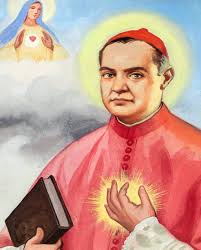
Anthony Mary Claret was born in Sallent, Barcelona, Spain on December 23, 1807, fifth of eleven children. His father, Juan worked in a wool manufacturing company, and his mother Josefa was a homemaker.
As a child, Anthony went to school in Sallent and was raised in the Catholic faith. One of the things he enjoyed was visiting the Shrine of Our Lady of Fussimanya that was near where he lived.
When he was 12, Anthony became a weaver. When he was 18, he went to Barcelona to become a Jacquard loom programmer, one of the early forms of modern data processing for textile machines. During his stay in Barcelona, Anthony also mastered Latin, French, and engraving.
By the age of 20, however, Anthony felt he was becoming burned out with his work and felt a call to the priesthood, religious life, or both. Though he thought of becoming a Carthusian monk, he entered the diocesan seminary at Vic in 1829 and was ordained on the feast of St. Anthony of Padua, June 13, 1835.
With a gift from his home parish, Father Anthony was able to continue studying theology until 1929. Despite his excellent academic ability, he felt drawn to become a missionary. Therefore, he entered the Jesuits in Rome but had to leave during his novitiate because of ill health. He then returned to Spain and served in Viladrau and Girona, making a name for himself as a lover of the poor. While there, he began practicing “rustic medicine,” a form of homeopathy.
Because of his facility in speaking Catalan, Father Anthony was then sent to work as apostolic missionary throughout Catalonia. His preaching in Catalan was so excellent, that people came from all over to hear him, and after preaching, he would spend many hours celebrating the Sacrament of Reconciliation for the people.
Unfortunately, in 1848, Father Anthony had to leave Catalonia because anti-clerical enemies were threatening to kill him. He went to the Canary Islands for 15 months where he continued to preach and give retreats. Sometimes, the crowds he attracted were so great, he had to preach in the plaza in front of the churches.
After his exile in the Canary Islands, Father Anthony returned to Spain and founded a new religious order on July 16, 1849, the Missionary Sons of the Immaculate Heart of Mary, commonly known today as the Claretians. Pope XI formal approval of the order on December 22, 1865. Claretian Fathers Esteban Sala and José Xifré are often considered “co-founders” with Anthony.
In 1849, the pope named Father Anthony to become the archbishop of the Archdiocese of Santiago in Cuba. As archbishop, Anthony erected hospitals and schools, including vocational schools. He also established credit unions for the for the poor, and he was a frequent visitor to hospitals and prisons. He also established a religious order for women with María Antonia Paris called the Religious of Mary Immaculate in 1855.
Archbishop Anthony was also a noted writer, not only of spiritual and religious books, but also about agricultural methods that he had tested before writing about them. He also wrote a couple of books about Cuba.
In early 1857, he was called back to Spain to be the confessor to Queen Isabela II. However, he made sure his assignment would not involve getting involved in court life. For nine years, he devoted himself to serving the poor and leading a school where he created a scientific laboratory, library, museum of natural history, college, and schools of music and languages. In 1868, however, the archbishop fled with the queen to France when their lives were threatened in a revolution.
On October 24, 1870, Anthony died in a Cistercian abbey in southern France where he had retired. He was canonized on May 7, 1950, and Saint Anthony Mary Claret’s feast day is October 24. He is a patron saint of textile workers, the Catholic press, dioceses of the Canary Islands, the Claretians, and others.
Today, the Claretians continue their work throughout the world in a variety of ministries.