 IFTTT Autopost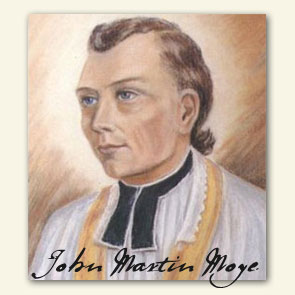
JeanJean-Martin Moyë was born on January 27, 1730, in Cutting, Bailiwick of Dieuze, Duchy of Lorraine (France), sixth of thirteen children of Jean Moyë and Anne Catharine Demange. The family was a long-established farming one in the area, and they were noted for being fervent in their Catholic faith. In addition to Jean-Martin who became a priest, his brother, five first cousins, and two nephews also became priests.
Jean-Martin received his early education from his older brother, Jean-Jacques, a seminarian who died when he was 24. Jean-Martin then finished his basic studies at the College of Pont-à-Mousson and then at the Jesuit College in Strasbourg, Germany. In fall of 1751, Jean-Martin began his studies in the diocesan seminary of Saint-Simon in Metz and was ordained a priest on March 9, 1754 by the bishop of Metz.
Fortunately for him, Father Jean-Martin received a grant from the Duke of Lorraine. With the money from the grant, the new priest served three parishes of Metz and was confessor for the seminarians at Saint-Simon.
Father Jean-Martin’s parishes included the hamlets of the countryside outside of the city of Metz, and it was in these communites that Father Jean-Martin realized that the girls of the rural areas lacked a quality education. Therefore, he sought volunteer teachers. The first was a working class woman named Marguerite Lecomte whom he stationed in the hamlet of Saint-Hubert on January 14, 1762. Amazingly, the woman served in this post unharmed even through the French Revolution. In time, Father Jean-Martin sent volunteer to areas in Germany also.
Father Jean-Martin also wrote some tracts about various aspects of the Faith, to educate the people. The tracts, however, even though they had ecclesiastical approval, caused a flurry of opposition from midwives and other priests. As a result of the opposition, the bishop removed Father Jean-Martin from his post in Metz and sent him to another region, Dieuze, and he forbid him to send any more volunteers to teach.
Like all people, Father Jean-Martin was not perfect. In fact, he was critized for being too rigid with parishioners and for those who wanted to celebrate the Sacrament of Reconciliation. He was also sort of a “killjoy,” opposing the traditional festivals of the people. As a result of the oppostion, the bishop removed him from his post in Dieuze during Holy Week in 1767. For the next year and half, Father Jean-Martin found himself living in an abbey and acting as a roving priest, helping out in various parishes when he could.
While in the abbey, Father Jean-Martin vocational goals became chrystalized. First, he wanted to focus on improving education, and second, he wanted to beome a missionary in Asia.
To prepare for the missions, Father Jean-Martin went to the seminary run by the Parish Foreign Missions (M.E.P.). After taking some mission coursees, he visited some of the volunteers he had recruited to teach. Now, this group was a formal religious order called the Sisters of Divine Providence. He spent his time preparing for mission work by renouncing his family inheritance and conducting parish missions in the area.
He was assigned to serve in the apostolic vicariate of Szechwan in western China. Before leaving, he appointed one of the Sisters, Marie Morel, as the first mother superior, and he asked two priest colleagues to watch over the new order for him.
Father Jean-Martin left France for China on December 30, 1771 and returned to Paris on June 5, 1784. For more than a decade, he served as a missionary in China. One of the main things he accomplished there was founding, in 1782, a group of women devoted to caring of the sick and instructing women and children in the faith. He called the group the “Christian Virgins.” They followed the ruless of the Sisters of Divine Providence in France.
When he returned to France in 1784, he continued to serve the Sisters and evangelize Lorraine and Alsace by preaching missions.
When the French Revolution of 1791 came, he and the Sisters retired to Trier. There, an epidemic of typhoid fever broke out, and the Sisters and Father Jean-Martin Sisters served as nurses in the hospital. Father Jean-Martin was one of the ones contracting typhoid fever from nursing the sick, and he died on May 5, 1793.
Father Jean-Martin was beatified on November 21, 1954. Blessed Jean-Martin Moyë’s feast day is May 4.